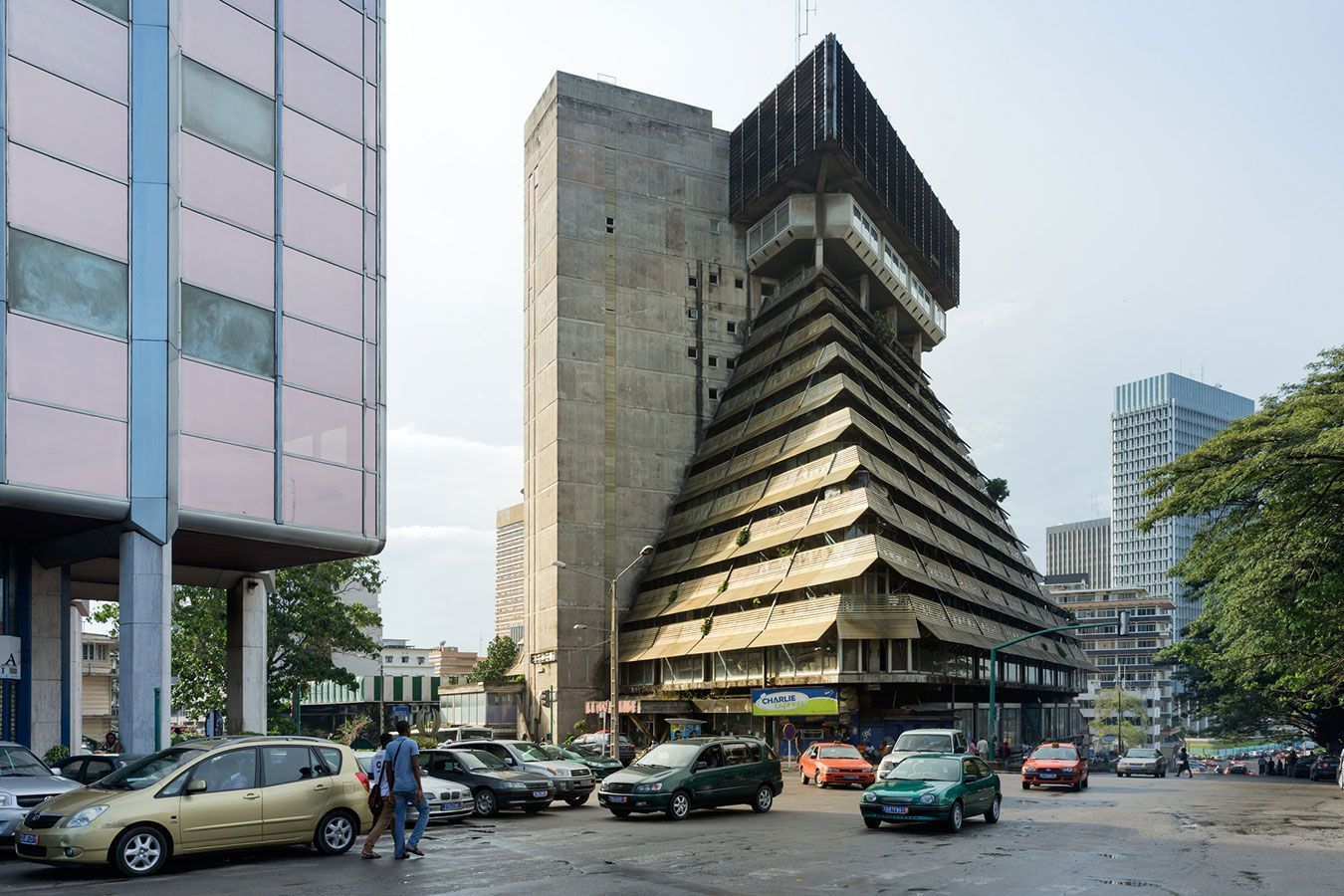
La Pyramide is a pioneering example of modernist and brutalist architecture in West Africa. Designed by Italian architect Rinaldo Olivieri and completed in 1973, this 15-story concrete marvel was envisioned as a mixed-use hub combining commercial, residential, and office functions. It remains an emblem of Abidjan’s 1960s–70s “Ivorian Miracle” and a candidate for urban renewal amidst ongoing deterioration.
La Pyramide emerged during Abidjan’s post-independence economic boom as a bold synthesis of market typology and high-rise living. Olivieri’s design included a central commercial atrium with ascending terraces, aiming to recreate the vibrancy of a traditional African souk within a concrete frame. The upper floors offered residential and office space, while subterranean levels supported leisure and service activities including a disco, supermarket, and archives.
Despite its initial prominence, inefficiencies in spatial layout—excessive circulation and rising maintenance costs—led to its decline. By the mid-1980s, tenants abandoned the building and it sank into neglect, suffering fire damage in 2015 and long-term deterioration .
The structure is now a testament to Africa’s brief encounter with brutalist aspirations. A 2011 public–private initiative announced renovation ambitions (€27 million / 18 billion CFA), though land disputes stalled progress. A 2021 decision returned ownership to the state, promising future rehabilitation and recognition as an architectural landmark akin to Abidjan’s version of a pyramid-shaped Gotham building.
- Dimensions: 15 floors above ground, 3 basement levels, total height approx. 62 m; roof-equipped for commercial and residential use.
- Style: Brutalist modernist, with stepped concrete terraces forming a distinct pyramid shape; designed to evoke a covered African marketplace.
- Original Program: Ground-level marketplace and retail; above — offices, studios, residences; underground — supermarket, parking for up to 1,800 cars, nightclub, archive spaces.
- Heritage Status: Iconic within Côte d’Ivoire’s modern architectural heritage; subject of government renovation campaigns since 2011.
- Conservation Status: Abandoned since late 1980s; deteriorated and deemed structurally unsafe by the 2000s; partially repossessed in 2021—future restoration planned.
.
Source: Wikipedia, SOAS African State Architecture, Lonely Planet, Le Monde.