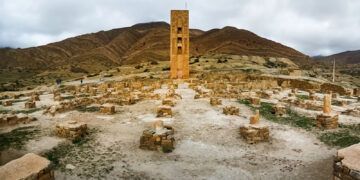
UNESCO World Heritage Site since 1987.
Aït Benhaddou is a spectacular example of southern Moroccan earthen architecture—a fortified ksar nestled on the Ounila River and flanked by the High Atlas foothills. Once a thriving village on ancient caravan routes, it epitomizes centuries‑old oasis culture.
Perched on a hillock overlooking an oasis, Aït Benhaddou embodies the cultural landscape of an “oasis of clay and palm” crafted for desert commerce and communal living. The ksar comprises a cluster of connected kasbahs built by different families, linked by narrow passageways, alleys, and vaulted archways that create an intimate fortified settlement.
Its smooth, battered walls—reinforced with flat-roofed watchtowers—blend defensive function with elegant form, demonstrating sophisticated earthen engineering . The ksar’s spatial organization—granaries on the upper terraces, communal spaces in the center—reflects socio-economic hierarchy and adaptation to a desert-margin environment.
Used as a backdrop in major films and series—Gladiator, Lawrence of Arabia, Game of Thrones, and more—Aït Benhaddou bridges living heritage and cinematic narrative, drawing international attention.
Today it stands as both a historical settlement and a cultural monument, welcoming visitors, small-scale artisans, and heritage-program support. Its inclusion in ongoing conservation frameworks reflects its global and local significance. The ksar remains a vibrant reminder of pre-modern trade networks and earth-based architecture—an emblem of resilience and identity in southern Morocco.
.
Sources: UNESCO World Heritage Centre, Wikipedia, ArchEyes / History Hit / worldheritagesite, Craterre, Rethinking The Future / Kenzly.