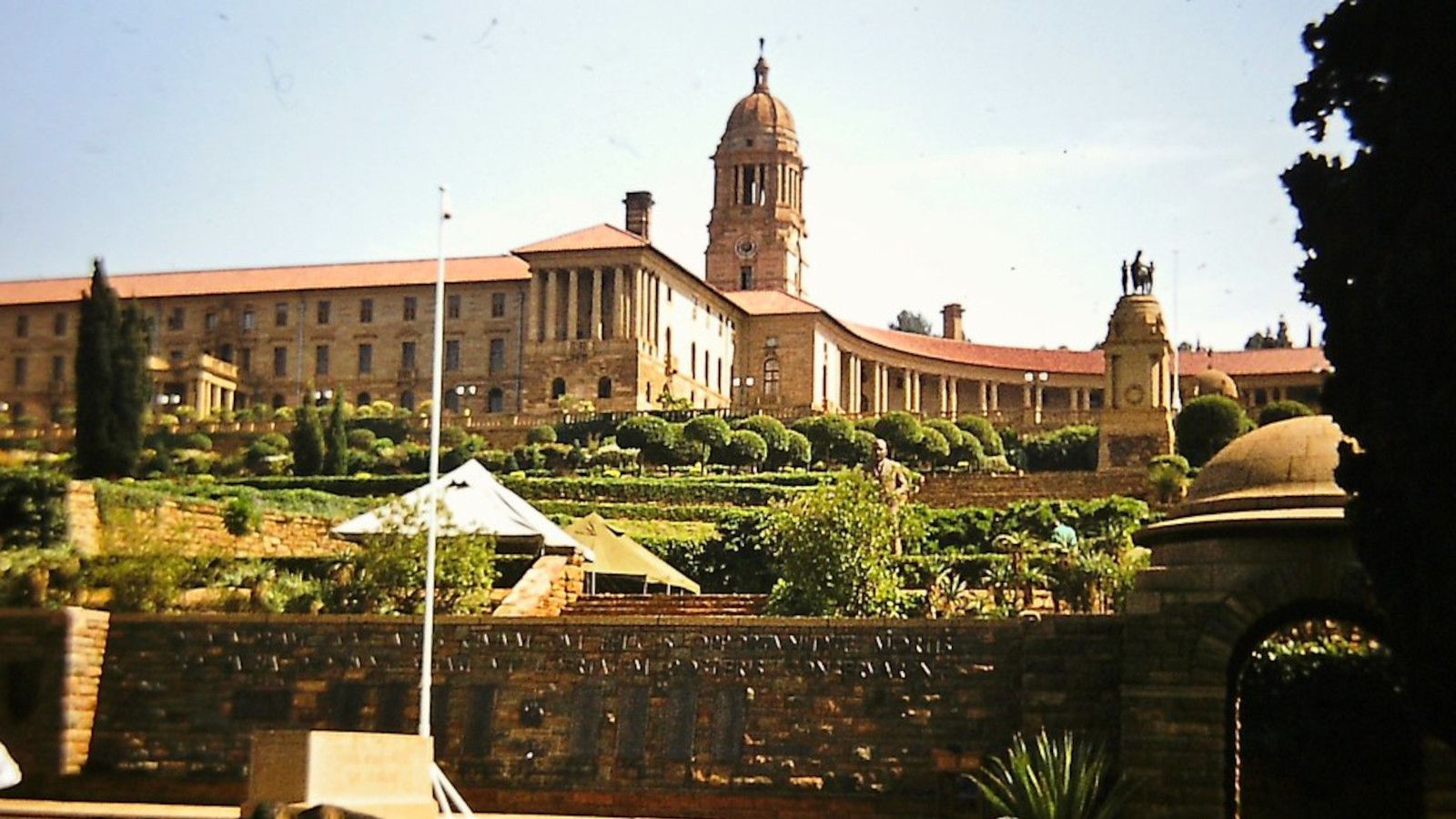
Standing atop Meintjieskop hill in Pretoria, the Union Buildings are among South Africa’s most important architectural and political landmarks. Designed by British architect Sir Herbert Baker, this monumental government complex was commissioned to symbolize the unity of the Union of South Africa following its establishment in 1910. Built from local sandstone, the building spans a sweeping semi-circular arc over 285 meters, flanked by twin domed towers intended to represent the English and Afrikaans-speaking populations.
The complex combines elements of Cape Dutch, Edwardian, and Neoclassical architecture. Its layout includes formal terraced gardens cascading down the hill, an amphitheatre built into a former quarry, and carefully selected indigenous vegetation. The structure’s interiors feature finely carved stinkwood and Rhodesian teak, while its façades showcase traditional arcades and monumental colonnades. Over 1,200 workers were involved in its construction, utilizing regional materials and craftsmanship.
The Union Buildings are not only the administrative seat of the South African presidency but also a powerful symbol of national reconciliation. They have been the site of historic political milestones, including the inauguration of President Nelson Mandela in 1994. The grounds host a series of national memorials, including the Delville Wood War Memorial and a towering 9-meter bronze statue of Mandela unveiled in 2013, facing the gardens in a gesture of open-armed unity.
Despite not being inscribed on the UNESCO World Heritage List, the site is officially recognized and protected under national heritage legislation. Conservation efforts ensure the maintenance of both architectural integrity and public access, as the Union Buildings continue to serve as a living symbol of the country’s democratic evolution.
Source: South African Heritage Resources Agency, South African History Online, UNESCO Tentative List documentation.