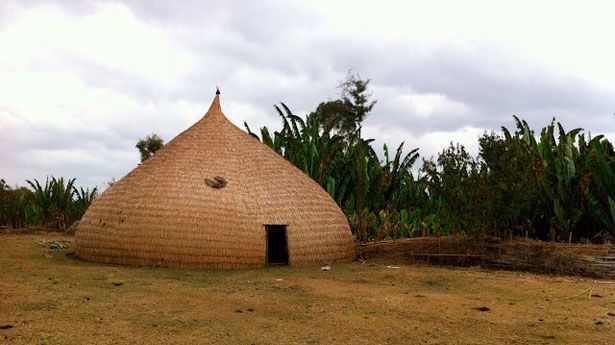
The Sidama roundhouse, locally known as a “tugul,” is a traditional vernacular dwelling emblematic of the Sidama people in southern Ethiopia. Crafted mainly from bamboo, it embodies sustainable, climate-adapted architecture rooted in community traditions and environmental responsiveness.
The Sidama tugul is a beehive-shaped house crafted from locally sourced bamboo and thatch. Across community-guided construction phases, a central pole is erected and encircled by a bamboo lattice wall, quickly forming a robust, self-supporting structure. A high, pointed dome roof ensures rapid runoff during heavy rains, minimizing water entry and prolonging structural life .
Inside, spaces are multifunctional—serving as sleeping, cooking, or storage areas—with partitions shifted as needed. Ventilation and thermal comfort arise naturally due to the breathable bamboo skin and high ceiling. Younger houses feature painted walls, showing aesthetic expression alongside functionality .
Beyond environmental efficiency, tuguls reinforce social cohesion: the building process is undertaken by Chinacho artisan teams supported by relatives—a ritual of cooperation and interdependence. This architecture stands as a sustainable model—low carbon, renewable, locally made—yet is challenged by declining bamboo access and pressure from modern materials.
.
Sources: Denamo A. Nuramo, Naturalhomes, SCIplanet.