UNESCO World Heritage Site since 1988.
Kairouan, established around 670 CE, is the first Arab-Muslim city in North Africa and a spiritual center of Islam, often referred to as the Maghreb’s fourth holy city. It rose to prominence in the 9th century under the Aghlabid dynasty, when it became a renowned hub of Islamic scholarship, religious authority, and urban planning.
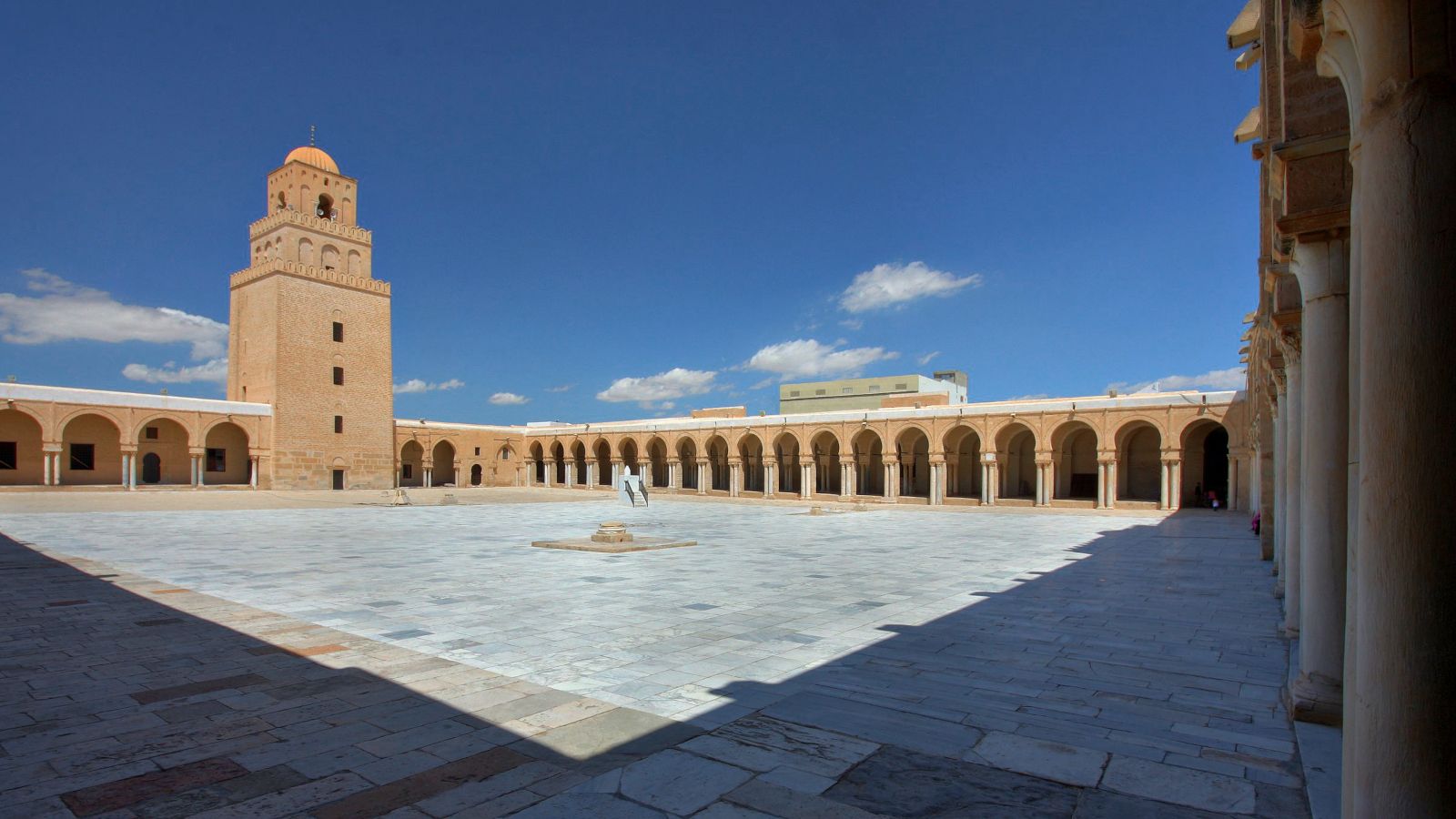
At its heart lies the Great Mosque of Kairouan, a monumental structure covering over 9,000 square meters. The mosque features a vast courtyard, a hypostyle prayer hall supported by more than 400 columns—many recycled from Roman and Byzantine ruins—and a massive square minaret, one of the earliest of its kind in Islamic architecture. Its richly adorned mihrab and the intricately carved wooden maqsura are among the oldest surviving features of their types in the Islamic world.
The city also houses the Mosque of the Three Doors, notable for its early sculpted façade, and the Aghlabid Basins, a remarkable example of medieval water engineering. These open-air reservoirs were constructed in the 860s to store water delivered by an aqueduct system from distant sources. Religious sanctuaries such as the Zawiya of Sidi Sahib maintain the city’s spiritual vitality.
Kairouan was inscribed on the UNESCO World Heritage List in 1988 under six criteria for its outstanding universal value. It is an exceptional example of Islamic architecture, urbanism, and continuity. Today, its monuments remain active sites of worship and community life. Conservation efforts focus on preserving traditional building techniques, maintaining the integrity of the city’s rammed-earth architecture, and protecting its hydraulic heritage.
Source: UNESCO World Heritage Centre, Britannica, ArchNet, Discover Islamic Art, Smithsonian Institution.