
UNESCO World Heritage Site since 2013.
The Historic Centre of Agadez, often referred to as the “Gateway to the Desert,” represents a unique urban legacy shaped by trans-Saharan trade and Tuareg settlement patterns. Originating in the 15th and 16th centuries during the height of the Sultanate of Aïr, Agadez marked a pivotal shift from nomadism to urban living among the Tuareg. Its development mirrors the transformation of a caravan stop into a vibrant socio-political and religious capital in the Sahel.
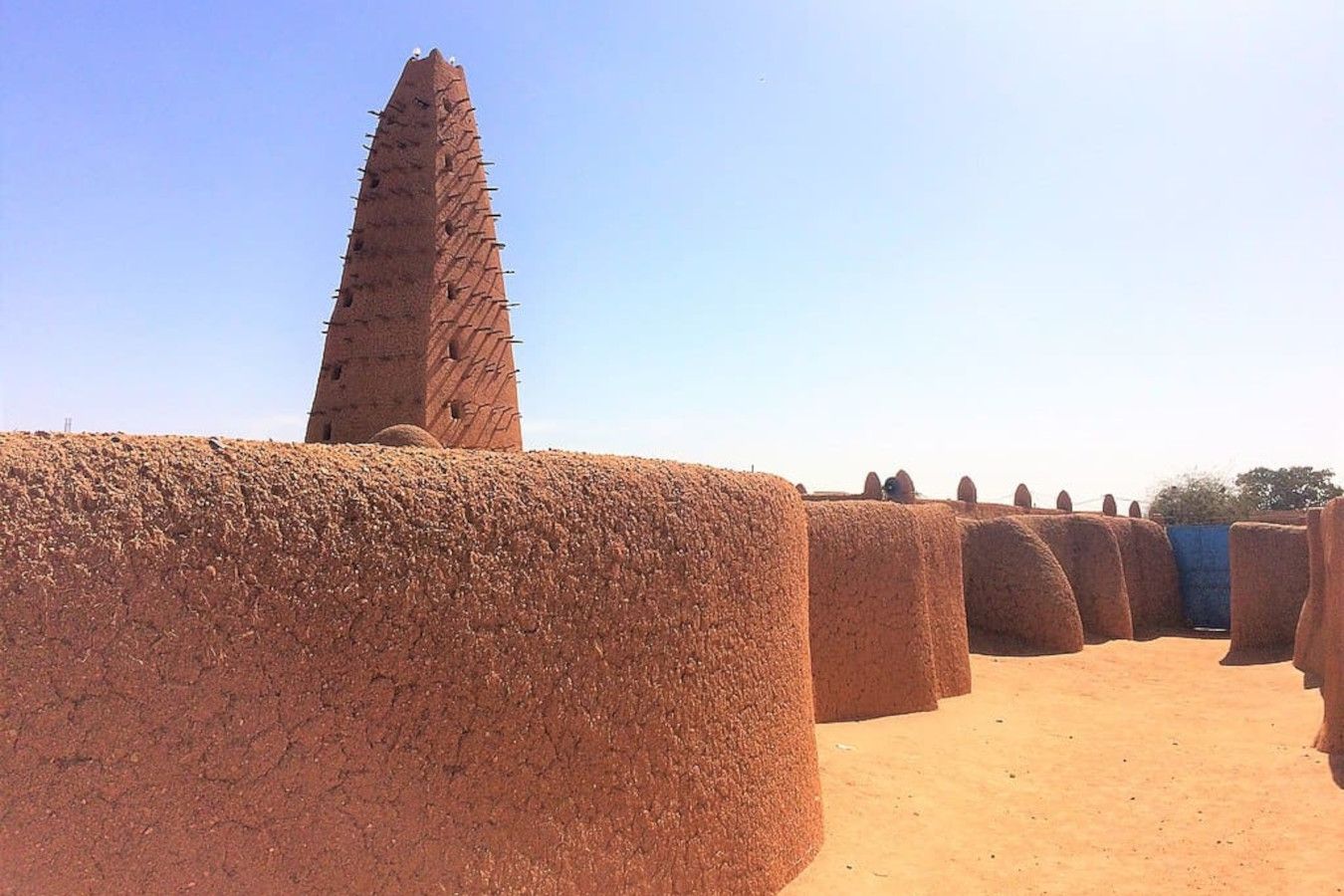
Architecturally, Agadez is a masterpiece of earthen construction. The city’s structures, built almost entirely from sun-dried mudbrick (banco), feature distinctive Sudano-Sahelian styles with elaborately decorated façades, arched niches, and wooden beam projections. The Grand Mosque of Agadez, with its 27-meter minaret, stands as the tallest mudbrick minaret in the world. Originally built in 1515 by Imam Bakhili and restored in 1844, it dominates the skyline and symbolizes both spiritual and architectural achievement.
The urban layout retains its original form, with irregular quarters shaped by ancestral encampments, narrow alleys, and central squares. The Sultan’s Palace and various religious and civic buildings reinforce the centre’s political and cultural roles. Residential architecture, often adorned with ornamental plasterwork, demonstrates continuity of indigenous design and craftsmanship. Agadez remains a living city, where historic functions such as religious practice, governance, and local crafts are actively maintained.
Recognized by UNESCO in 2013 under criteria (ii) and (iii), Agadez exemplifies cultural interchange across the Sahara and the enduring traditions of mudbrick architecture. Despite modernization pressures—including the use of non-traditional materials and visual pollution—conservation initiatives are ongoing. These include heritage skills training and the reinforcement of traditional governance, contributing to the preservation of the city’s authenticity and integrity.
Source: UNESCO World Heritage Centre, Britannica, ArchNet, World Heritage Site review, Smithsonian Institution.