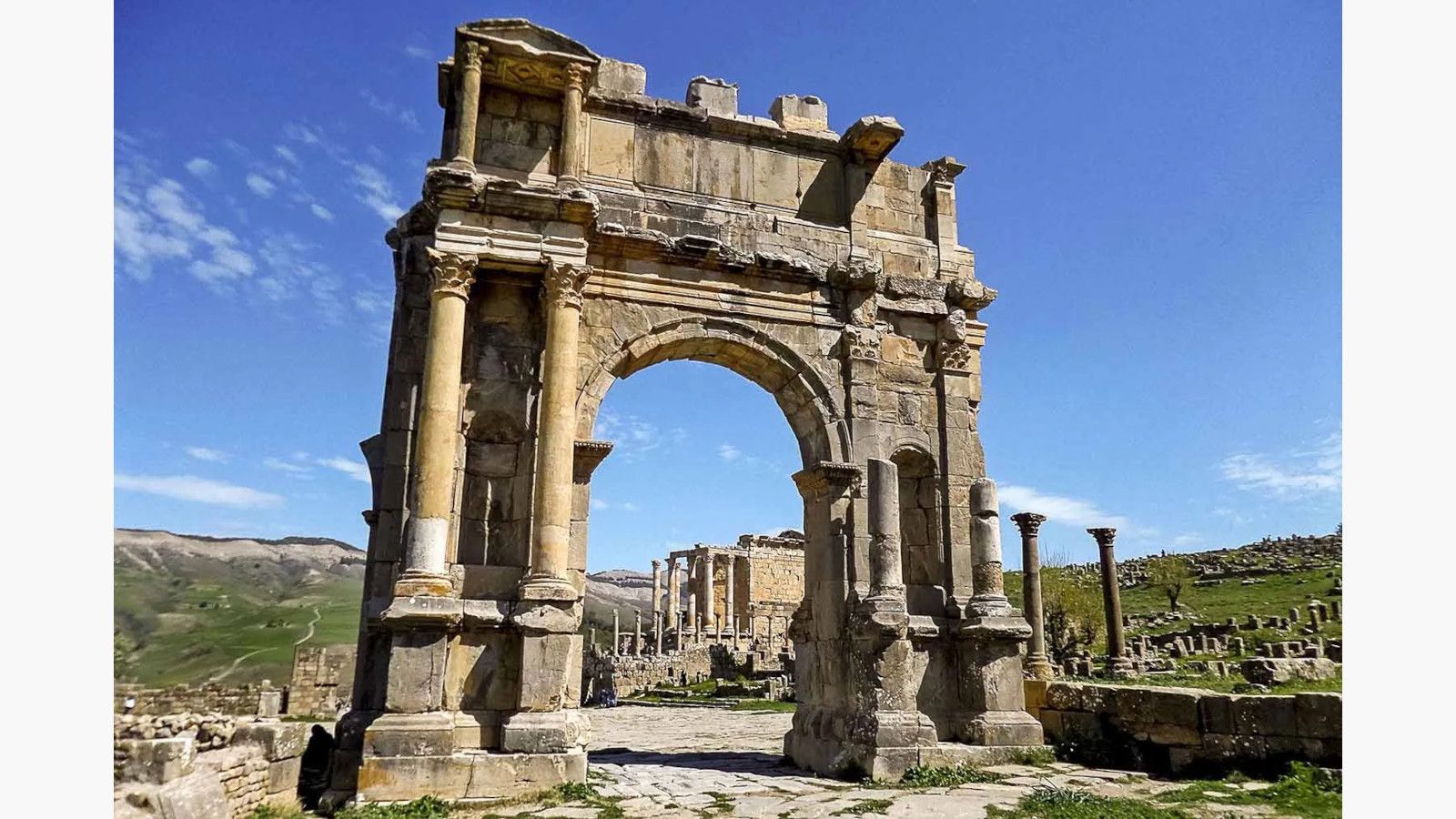
UNESCO World Heritage Site since 1982.
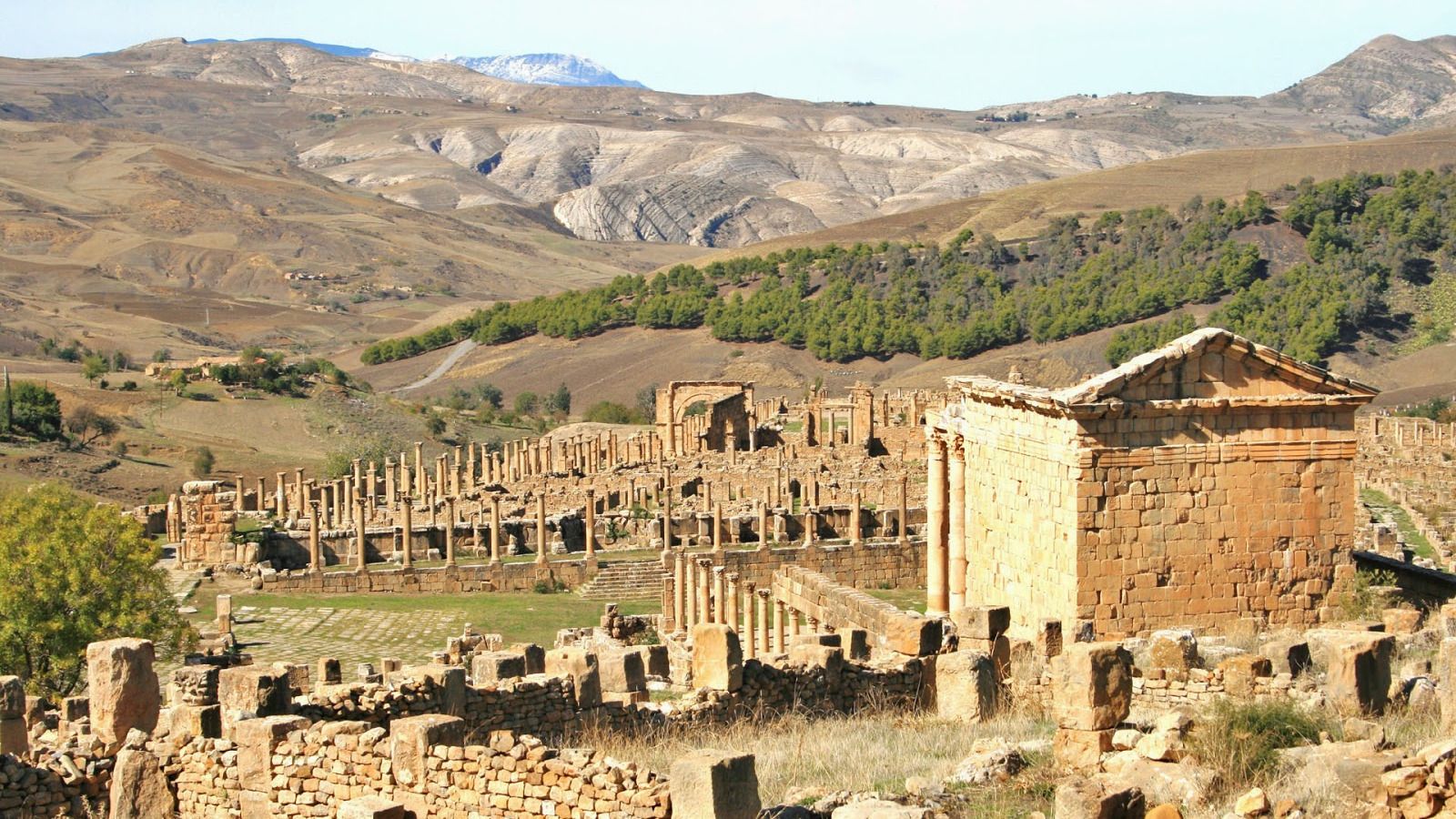
Djémila, originally known as Cuicul, is among the best-preserved Roman towns in North Africa. Founded at the end of the 1st century AD under Emperor Nerva on a defensible mountain spur at 900 meters elevation, its urban layout reflects both the standard Roman orthogonal grid and unique adaptations to its rugged terrain. The settlement includes well-defined Cardo and Decumanus streets, multiple Roman fora, a theatre, temples, triumphal arches (notably the Arch of Caracalla), residential houses with peristyles, and a later Christian quarter featuring basilicas and a baptistery.
Among its most significant architectural elements is the Severan Forum, framed by the Arch of Caracalla, erected in 216 AD. This arch features a single fornis, Corinthian columns, and statuary attics depicting Caracalla, his mother Julia Domna, and his father Septimius Severus. Several private villas within the city—such as the House of Dionysus and the Casa del Asno Victorioso—are renowned for their elaborate floor mosaics, reflecting mythological themes and domestic rituals. These homes also include private baths, atriums, and garden courtyards that illustrate the comfort and refinement of elite Roman life.
During Late Antiquity, Djémila witnessed a strong Christian presence, leading to the construction of churches, baptisteries, and clerical residences between the 4th and 6th centuries. The town gradually declined following the Vandal invasions in the 5th century, a brief Byzantine occupation, and its eventual abandonment in the 7th century after the Arab conquest.
Archaeological excavations began in 1909 and have since led to careful preservation and restoration of monuments. Today, many original mosaics and artifacts are displayed in the on-site Djémila Museum. In recognition of its historical and architectural significance, UNESCO inscribed Djémila as a World Heritage Site in 1982.
Source: Wikipedia, UNESCO World Heritage Centre, African World Heritage Sites, Zamani Project.