UNESCO World Heritage Site since 1982.
Tipasa is a remarkable coastal archaeological site that traces a continuum of civilizations spanning more than a millennium. Initially established as a Punic trading post in the 6th century BCE, it flourished under Roman rule from the 1st century CE, becoming an important military and commercial colony on the southern Mediterranean frontier. The site’s classical Roman plan features a forum, curia, basilica, baths, amphitheater, theater, aqueducts, and a grid of paved streets—an exemplary Roman town integrated into North Africa’s geography.
What sets Tipasa apart is its layered cultural legacy. Roman temples dedicated to Jupiter and other deities stand near Phoenician vestiges, while early Christian monuments attest to its spiritual role in Late Antiquity. The Great Basilica, Basilica of St. Salsa, and Christian necropolises bear witness to the spread of Christianity before the Islamic era. These churches, often built with local stone and decorated with mosaic floors, are among the most significant early Christian remains in the Maghreb.
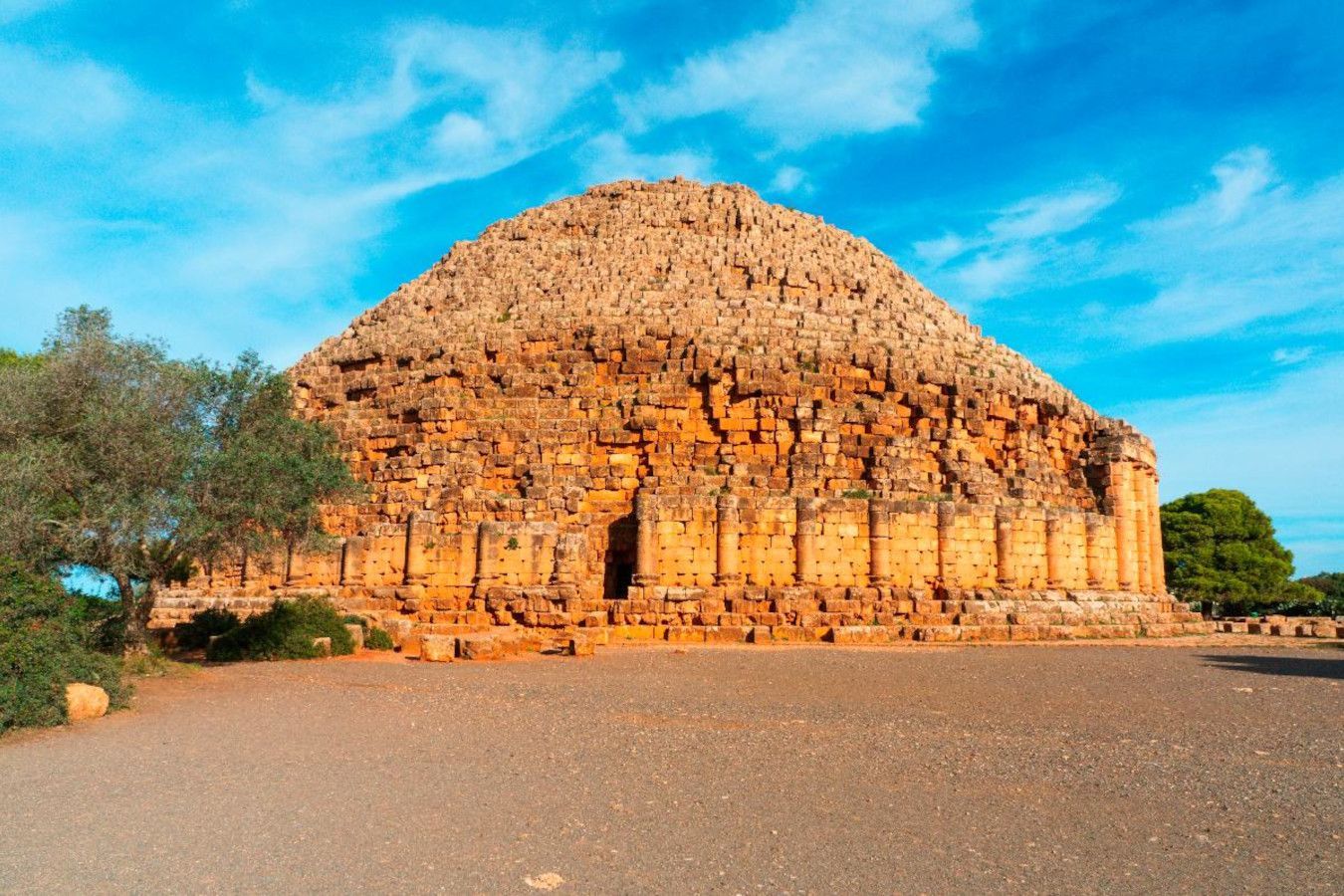
Overlooking the town from a separate hill is the Royal Mausoleum of Mauretania, a massive circular tomb built around the 1st century BCE. Likely constructed for King Juba II and Queen Cleopatra Selene II, it blends local Berber design with Roman and Hellenistic elements—underscoring Tipasa’s syncretic character.
Despite modern pressures and past inclusion on UNESCO’s endangered list, Tipasa has benefitted from targeted conservation. Measures have addressed sea erosion, vegetation damage, and encroaching development. Today, the site continues to reveal its complex past amid a scenic coastal setting of olive groves and Mediterranean flora. Tipasa stands as a unique testimony to the fusion of indigenous and imperial cultures along the African shore.
Source: UNESCO World Heritage Centre, Encyclopaedia Britannica, African World Heritage Sites, ArchNet, Musée Public de Tipasa.